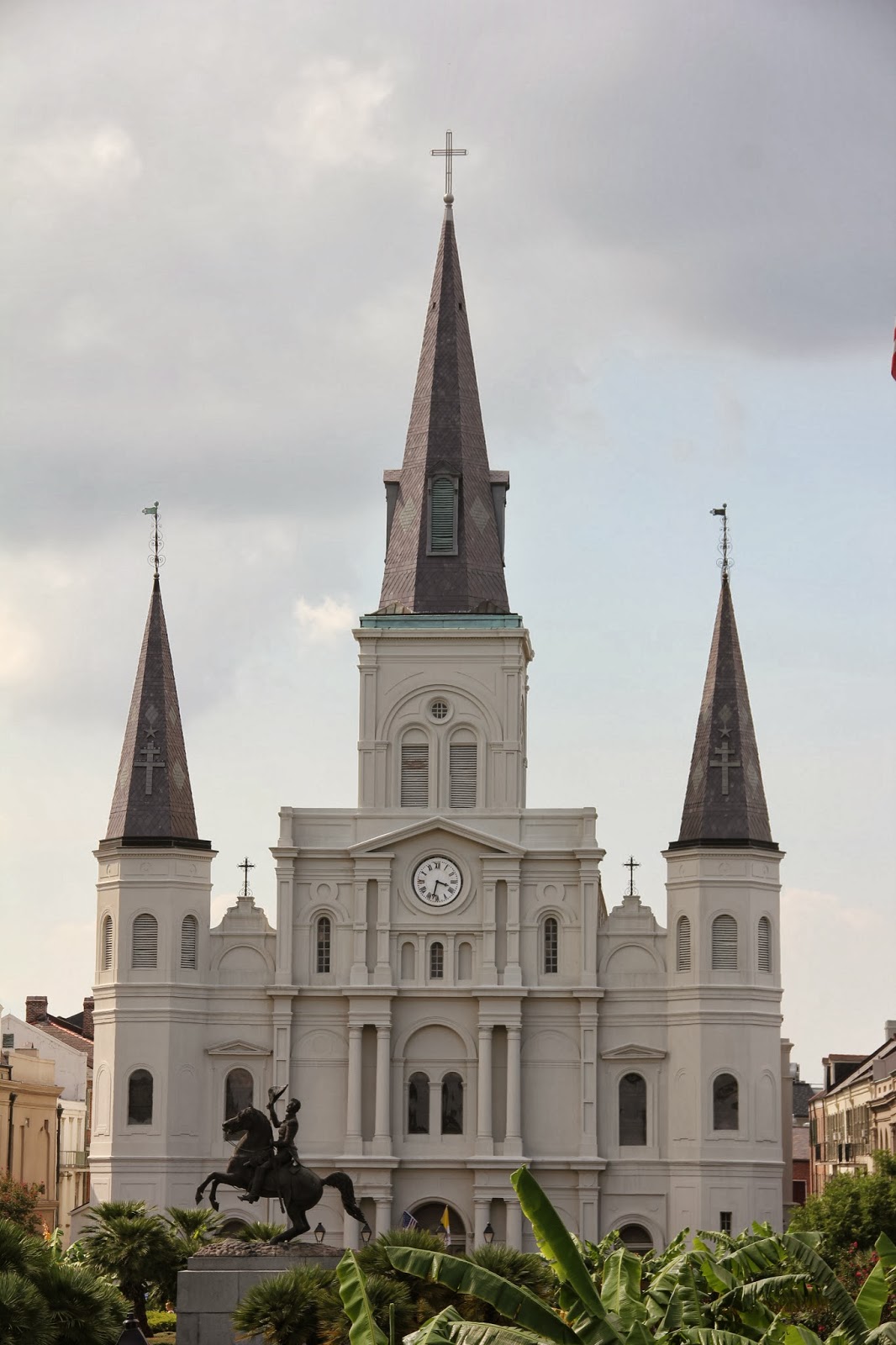
Jackson Square, is a historic park in the French Quarter of New Orleans, Louisiana. It was declared a National Historic Landmark in 1960.
It was designed after the famous 17th-century Place des Vosges in Paris, France, by the architect and landscape architect Louis H. Pilié. Jackson Square is roughly the size of a city block.
Sculptor Clark Mills's statue of Battle of New Orleans hero and future U.S. President Andrew Jackson, for whom the square was named in 1815, was erected in 1856. Iron fences, walkways, benches, and Parisian-style landscaping remain intact from the original design by Baroness Micaela Almonester-Pontalba in 1851.
The flagpole, commemorating the city's transfer from Spain to France to the United States in 1803, symbolizes the square's rich cultural history. Throughout the 1930s, the Works Progress Administration (WPA) repainted facades, renovated surrounding buildings, and improved landscaping around the square.
Because Jackson Square has been the center of life for many centuries, it is no wonder that many of the city’s tarot readers congregate here to offer their services. A city filled with religious diversity and historic charm makes Jackson Square a significant environment to boast its culture.
By the 1920s, the Square was a haven for artists from professionals to students. The 1960s and 1970s saw the beginnings of the Square as a place of business for pagans and New Age devotees telling fortunes and reading palms and tarot cards.
One of the most influential early tarot readers was Jerik Danerson. Born in California in 1946, Jerik developed a strong early interest in ancient religions, particularly the Norse traditions. He became immersed in modern paganism in the 1960s and made his way to New Orleans. Setting up a tarot and palm-reading stand in Jackson Square, Jerik went on to found a new path of Wicca known as Southshire, which in turn influenced countless additional paths.
The square has been the site of hundreds of live music events, including the September 9, 2010 Dave Matthews Band and Taylor Swift performance for the Super Bowl Champion New Orleans Saints 2010 NFL Season kickoff.
Jackson Square has been filmed in numerous television shows and movies. Among these are the films Angel Heart, The Curious Case of Benjamin Button, King Creole, and television series K-Ville,Treme and Memphis Beat.